Snoring & Sleep Apnea Surgery
Dr. Alen Cohen and Dr. Jerome Vener at C/V ENT Surgical Group, serving the Los Angeles and Thousand Oaks areas, are experts in the diagnosis and treatment of snoring and sleep apnea. They will start with obtaining a thorough history of your concerns and symptoms and subsequently perform a workup to diagnose the cause of your sleep disorder. Once a diagnosis is reached, whether this may be simple snoring or severe obstructive sleep apnea (OSA), they can guide you regarding which treatment options may be best to help you obtain restful sleep not only for you but also for your bed partner. These options are detailed below and they include various procedures including in-office procedures with minimal downtime to more invasive surgical procedures.
What is obstructive sleep apnea (OSA)?
Sleep apnea is a common disorder that can be very serious. In sleep apnea, your breathing stops or gets very shallow while you are sleeping. Each pause in breathing typically lasts 10 to 20 seconds or more. These pauses can occur 20 to 30 times or more an hour.
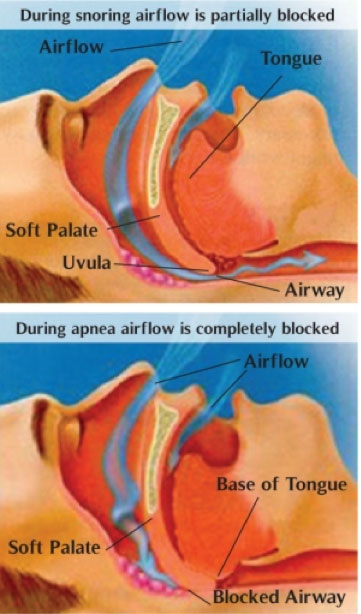
The most common type of sleep apnea is obstructive sleep apnea. During sleep, enough air cannot flow into your lungs through your mouth and nose even though you try to breathe. When this happens, the amount of oxygen in your blood may drop. Normal breaths then start again with a loud snort or choking sound.
When your sleep is upset throughout the night, you can be very sleepy during the day. With sleep apnea, your sleep is not restful because:
- These brief episodes of increased airway resistance (and breathing pauses) occur many times.
- You may have many brief drops in the oxygen levels in your blood.
- You move out of deep sleep and into light sleep several times during the night, resulting in poor sleep quality.
People with sleep apnea often have loud snoring. However, not everyone who snores has sleep apnea. Some people with sleep apnea don’t know they snore.
- Sleep apnea happens more often in people who are overweight, but even thin people can have it.
- Most people don’t know they have sleep apnea. They don’t know that they are having problems breathing while they are sleeping.
- A family member and/or bed partner may notice the signs of sleep apnea first.
Untreated sleep apnea can increase the chance of having high blood pressure and even a heart attack or stroke. Untreated sleep apnea can also increase the risk of diabetes and the risk for work-related accidents and driving accidents.
What causes sleep apnea?
Sleep apnea happens when enough air cannot move into your lungs while you are sleeping. When you are awake, and normally during sleep, your throat muscles keep your throat open and air flows into your lungs. In obstructive sleep apnea (OSA), however, the throat briefly collapses, causing pauses in your breathing. With pauses in breathing, the oxygen level in your blood may drop. This happens if the following conditions occur:
- Your throat muscles and tongue relax more than is normal.
- Your tonsils and adenoids are large.
- Your nose is obstructed due to a deviated septum, large turbinates or nasal polyps.
- You are overweight.
- The extra soft tissue in your throat makes it harder to keep the throat area open.
- The shape of your head and neck (bony structure) results in somewhat smaller airway size in the mouth and throat area.
- You have a very floppy palate with a thick or long uvula.
- You have a very large base of tongue that flops back and blocks your breathing.
With these areas in your nose and throat being partly blocked during sleep, enough air cannot flow into your lungs, even though your efforts to breathe continue. Your breathing may become hard and noisy and may even stop for short periods of time (apneas).
Another rare type of sleep apnea, termed central sleep apnea, happens when the area of your brain that controls your breathing doesn’t send the correct signals to the breathing muscles. Then there is no effort to breathe at all for brief periods. Snoring does not typically occur in central apnea and is not treated by our surgeons.
Who is at risk for obstructive sleep apnea (OSA)?
Anyone can have obstructive sleep apnea.
It is estimated that more than 12 million Americans have obstructive sleep apnea. More than half the people who have sleep apnea are overweight, and most snore heavily.
Sleep apnea is more common in men. One out of 25 middle-aged men and 1 out of 50 middle-aged women have sleep apnea that causes them to be very sleepy during the day. Sleep apnea is more common in African Americans, Hispanics, and Pacific Islanders than in Caucasians. If someone in your family has sleep apnea, you are more likely to develop it than someone without a family history of the condition.
Adults who are most likely to have sleep apnea:
- Snore loudly.
- Are overweight.
- Have high blood pressure.
- Have a decreased size of the airways in their nose, throat, or mouth. This can be caused by the shape of these structures or by medical conditions causing congestion in these areas, such as hay fever or other allergies.
- Have a family history of sleep apnea.
Obstructive sleep apnea can also occur in children who snore. If your child snores, you should discuss it with our physicians.
What are the symptoms of obstructive sleep apnea (OSA)?
The most common signs of sleep apnea are:
- Loud snoring
- Choking or gasping during sleep
- Fighting sleepiness during the day (even at work or while driving)
Your family members may notice the symptoms before you do. Otherwise, you will likely not be aware that you have problems breathing while you are asleep.
Others signs of sleep apnea may include:
- Morning headaches
- Memory or learning problems
- Feeling irritable
- Not being able to concentrate on your work
- Mood swings or personality changes perhaps feeling depressed
- Dry throat when you wake up
- Frequent urination at night
How is obstructive sleep apnea (OSA) diagnosed?
Your doctors will do a physical exam, take a medical history that includes asking you questions about how you sleep and how you function during the day and have you fill out a detailed questionnaire that will risk-stratify you in relation to your snoring and sleep apnea. As part of the exam, your doctor will check your mouth, nose, and throat to determine areas of obstruction. For example, a deviated spetum, large turbinates, enlarged tonsils, a long or thick uvula (the tissue that hangs down in the middle in the back of your throat), a floppy soft palate or a large base of tongue. Your doctor may order a sleep recording if your symptoms are severe enough based on your history, exam and questionnaire results to grade your sleep apnea into mild, moderate or severe types.
What are the treatment options for snoring and obstructive sleep apnea?
Continuous Positive Airway Pressure (CPAP):
Continuous positive airway pressure (CPAP) is the most common treatment for moderate to severe sleep apnea and is the gold standard for treatment, however many people cannot tolerate use of this cumbersome mask and machine. For this treatment, you wear a mask over your nose during sleep. The mask blows air into your throat at a pressure level that is right for you. The increased airway pressure keeps the throat open while you sleep.
If you are one of the many who cannot tolerate CPAP for one reason or another and you have mild to moderate sleep apnea you may be a candidate for one of the surgical treatment options the physicians at C/V ENT Surgical Group in Los Angeles utilize listed below, which include in-office procedures.
Pillar Implant Procedure
The revolutionary Pillar procedure, or palatal implants, is a new and minimally invasive modality approved by the FDA and is used to treat people with habitual snoring and those with mild-to-moderate OSA with excellent results. (read more)
Laser Assisted Uvulopalatoplasty (LAUP)
This is an older procedure utilized by most ENT’s prior to the pillar implant procedure as a treatment for snoring and mild to moderate sleep apnea. During this in-office procedure a rim of soft palate containing the uvula was removed using the CO2 laser. (read more)
Coblation
This includes a number of procedures which utilizes radiofrequency energy to ablate excess soft tissue whether this is in the nose (turbinates) or in the throat (base of tongue, soft palate, uvula, or tonsils). (read more)
Adenotonsillectomy
When children under the age of 13 are diagnosed with severe snoring or obstructive sleep apnea, this is often due to enlarged adenoids and tonsils. As a result these children would benefit from adenoidectomy and tonsillectomy if warranted by their history and physical exam. (read more)
Uvulopalatopharyngoplasty (UP3/UPPP)
Uvulopalatopharyngoplasty (UP3/UPPP) is quite an invasive procedure that entails a general anesthetic and involves removal of the tonsils, uvula, and part of the soft palate. In some patients, however, with moderate to severe OSA who cannot tolerate CPAP it is necessary. (read more)
Tongue Base Reduction
This is a procedure often used in combination with other procedures when a patient is in the operating room. The most common method used by Dr. Jerome Vener and Dr. Alen Cohen in Los Angeles to treat a large base of tongue is to use Coblation. (read more)
Genioglossus Advancement
This is a second-line procedure that is used occasionally in certain patients with a small receding chin (microgenia/retrognathia) to open the airway and treat severe obstructive sleep apnea. (read more)
Septoplasty
This is one of the most common procedures performed to improve nasal obstruction when necessary. The septum is made of bone and cartilage and is the dividing wall between the two nasal passages. (read more)
Submucous Resection of Inferior Turbinates
The turbinates are curved ridges along the sidewall of the nose on each side and are involved in humidification and filtration of the air we breathe in. There are 3 sets of turbinates on each side of the nose. (read more)
Back to Services